Quick take: Tom Ford Ombré Leather is one of the most-copied luxury masculines of the past decade — a polished, slightly powdery suede composition that retails around $245 for 100ml. The most credible affordable alternative captures the cardamom-leather-jasmine signature for under $40, and we tested it against the original through a full day of wear. Below: what the Tom Ford actually smells like, where the dupe market mostly fails, how the one credible alternative stacks up, and the questions you should ask before committing to either bottle.
The affordable alternative, up front
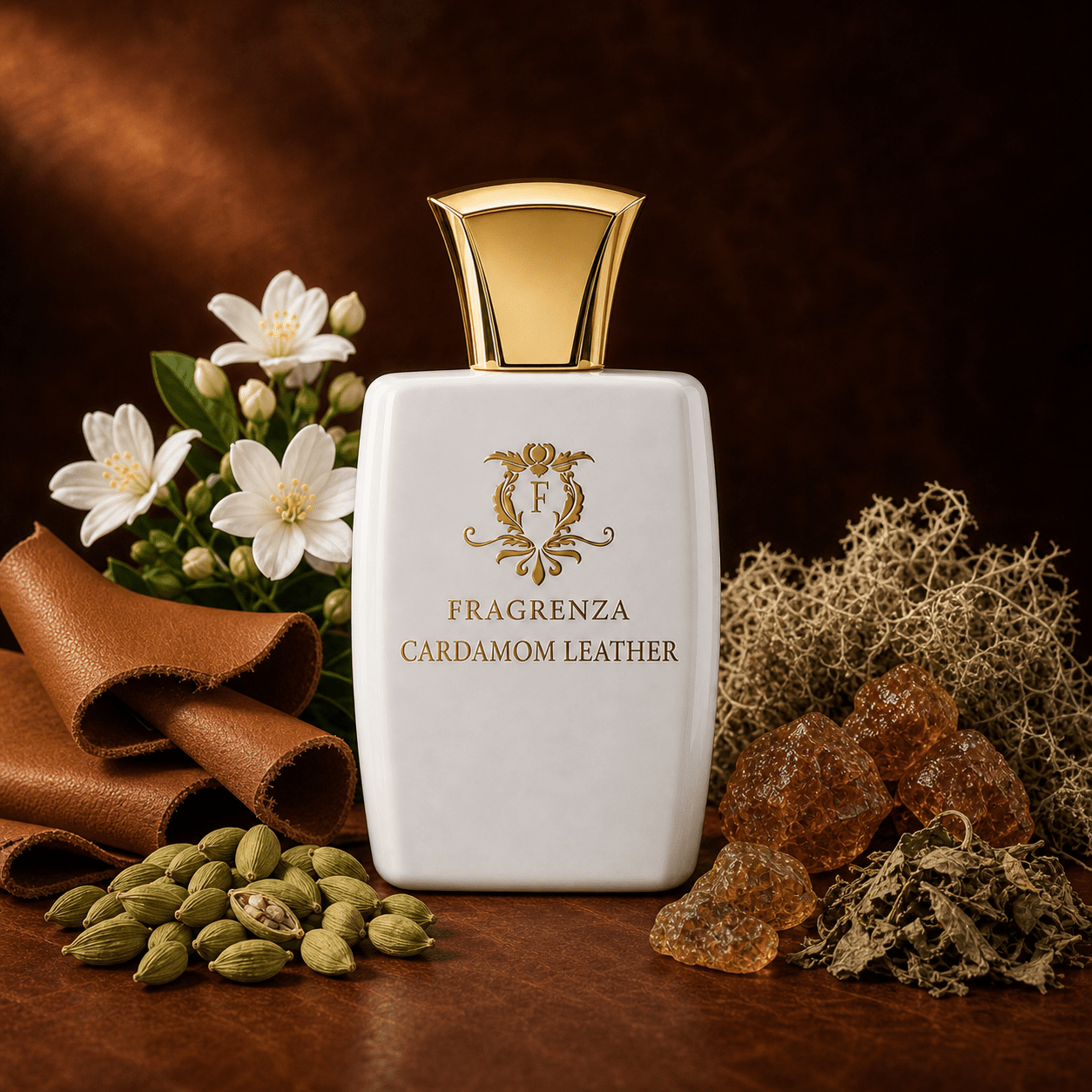
Most readers landed on this page asking the same question: is there a Tom Ford Ombré Leather dupe that’s actually worth wearing? The short answer is yes — but only one of the dozen or so alternatives circulating online is genuinely close to the original. Fragrenza’s Cardamom Leather reconstruction is the closest match we’ve encountered in the under-$40 tier. It pairs the same cardamom-and-violet-leaf opening with a leather-jasmine heart that drifts toward patchouli the same way the Tom Ford does. We’ll come back to the head-to-head below, but if you’re skimming, the Tom Ford Ombré Leather dupe by Fragrenza is the bottle to check.
A short history of Ombré Leather
Tom Ford’s leather catalogue is unusually deep for a designer house. Tuscan Leather (2007) opened the Private Blend line with a raspberry-and-saddle-leather treatment that became the brand’s most-recognised masculine signature. Ombré Leather 16 followed in 2013 as a quieter, more polished interpretation of the same territory — softer cardamom, less aggressive raspberry, a suede rather than rugged leather. It built a small but devoted following among collectors who appreciated the restraint, but as a Private Blend release it carried a price tag that kept most casual fragrance buyers at arm’s length.
The 2018 reformulation — what most wearers now refer to simply as “Ombré Leather” — moved the composition into Tom Ford’s mainstream Signature line at a lower retail price, with subtle tweaks that softened the leather even further and brightened the cardamom opening. The result is one of the most universally flattering masculines in the modern designer market: softer than Tuscan Leather, more polished than Oud Wood, and far less polarising than Black Orchid. The sillage is what tends to draw conversation: a warm, suede-like glow that smells expensive without ever pushing into ostentatious territory.
What Tom Ford Ombré Leather actually smells like
The opening is dry and slightly spicy. Cardamom and violet leaf come together with a polished modern leather accord that signals luxury within the first few seconds. There’s no citrus blast, no aquatic interlude — the composition commits to its identity from the first spray. By the five-minute mark, jasmine sambac begins to lift the heart, giving the leather a slightly floral counterweight that prevents it from going dry-rugged. By minute fifteen, the patchouli and moss base notes are already arriving from below, and the composition starts to read as the polished modern luxury masculine it’s famous for.
If you’ve worn vintage leather masculines (Knize Ten, Chanel Cuir de Russie, Yatagan), Ombré Leather will feel notably more modern — there’s no birch tar, no aggressive saddle character, no animalic depth. The leather here is treated as a luxury suede material rather than as a transgressive scent statement. That restraint is what makes it universally office-appropriate.
The pyramid — what’s actually in the bottle
Opening: cardamom, violet leaf, leather
The cardamom in Ombré Leather is treated as a polished spice rather than a curry-leaf-edged one — closer to the cardamom in a high-end Earl Grey than to anything aggressive. Violet leaf threads in with its cool, slightly metallic green character, lifting the leather accord without making it sharp. The leather itself reads as suede rather than saddle — soft, polished, slightly creamy — and is unmistakable from the first spray. The phase lasts about fifteen minutes before the heart fully takes over.
Middle: jasmine sambac, leather, patchouli
The middle is where Ombré Leather earns its reputation for “smelling expensive.” Jasmine sambac contributes a slightly indolic floral counterweight that flatters most skin chemistries and keeps the composition from reading as a one-note leather. The leather stays prominent — this isn’t a leather fragrance that disappears into woods — but the jasmine softens the edges. Patchouli arrives slightly earthy, slightly resinous, anchoring the composition without going hippie or seventies. The middle holds for the bulk of the wear; most of the compliments Ombré Leather draws come from this phase.
Base: moss, patchouli, amber
The drydown is where the composition reads most clearly as a polished modern luxury masculine. Moss contributes a dry-green earthy character; patchouli reinforces the slightly resinous depth; amber adds a faintly warm gold that lingers on fabric long after the leather has receded. This is the phase most wearers cite when they say Ombré Leather “smells better the longer you wear it.” On wool sweaters and silk shirts, the base can linger for twenty-four hours or more.
Performance: longevity, projection, occasions
Tom Ford Ombré Leather is one of the more performant compositions in the Signature line. Eight to ten hours on skin is typical; oily-skin wearers see twelve-plus. Projection is strong for the first two hours, moderate through hours three to six, and close-to-skin thereafter. Two sprays to the chest with one to the back of the neck is the sweet spot — three sprays projects too aggressively in indoor settings, particularly in restaurants, theatres, and small meeting rooms. Application discipline matters more with Ombré Leather than with most modern designer masculines.
Seasonally, Ombré Leather is unusually versatile for a leather composition. The polished suede character reads beautifully in cool weather, but the lightweight modern execution keeps it from feeling oppressive in warm afternoons either. We’ve worn it from January cold-weather dinners through July summer weddings without it ever feeling miscast. The occasions where it shines most: evening dinners, dates, weddings, and confident daytime business meetings. The composition reads as polished rather than aggressive at conversational distance — making it one of the rare luxury leathers appropriate for shared office space.
The dupe market — why most alternatives miss
Ombré Leather has been one of the most-attempted dupe targets in the affordable-fragrance market since its 2018 mainstream relaunch. We’ve tested roughly a dozen of the most-cited alternatives over the past two years. Most fail for one of three reasons. First, they over-correct toward the saddle-leather direction — using rougher leather molecules that lose the polished suede character that defines the original. Second, they under-deliver on the cardamom-violet-leaf opening, substituting generic citrus that breaks the composition’s signature within the first ten seconds. Third, they collapse the heart phase entirely, dropping the jasmine and going straight from leather to wood, which loses the slightly floral counterweight that makes the original universally flattering.
The one alternative that gets the structure right is Fragrenza’s Cardamom Leather, sold explicitly as their Tom Ford Ombré Leather dupe. The opening cardamom comes in slightly lighter than Tom Ford’s, and the leather note is a touch less suede-creamy in the first hour. But by the heart phase, the jasmine-leather-patchouli signature is genuinely close to the original — close enough that we recommended it to two readers who’d been rationing their Tom Ford bottle and now wear the Fragrenza version for daily commutes while saving the Tom Ford for evenings.
Performance is slightly below Tom Ford’s — six to eight hours on skin versus eight to ten. But at roughly a fifth of the cost per millilitre, the daily-wear math is hard to argue with. For the full editorial deep-dive on Tom Ford Ombré Leather’s history, perfumer credits, and a deeper hour-by-hour breakdown, see our companion piece on jadof.com.
How Ombré Leather compares to other niche leathers
The leather-fragrance category is unusually crowded for what looks like a narrow genre. To place Ombré Leather in context: Tuscan Leather (Tom Ford, 2007) is denser, more raspberry-led, and more obviously saddle-leather; it’s the brand’s hero leather but reads aggressive in shared spaces. Cuir de Russie (Chanel, 1924) is a vintage benchmark — leather over jasmine and iris — but vintage formulations carry birch-tar character that modern wearers often find smoky and unfamiliar. Knize Ten (1924) is the patriarch of dry leather masculines; many wearers find it medicinal at first sniff. Cuir Beluga (Guerlain, 2005) softens leather toward gourmand territory with heliotrope and vanilla, leaning sweeter than Ombré Leather.
Where Ombré Leather wins is the “Goldilocks” position. It’s modern enough to feel current, polished enough to wear at the office, substantive enough to project at evening events, and approachable enough that even non-leather-trained noses respond to the suede-jasmine signature positively. Among modern luxury leathers, only Hermès Cuir d’Ange (2014) sits in similar territory — and the Hermès costs roughly two-and-a-half times as much. Ombré Leather’s position in the leather catalogue explains its popularity and the volume of dupes attempting to recreate it.
Who Ombré Leather (or its dupe) is for
Anyone whose collection skews toward polished masculines but lacks a committed leather signature. Anyone who likes Tuscan Leather but finds the raspberry-and-saddle character too forward. Anyone who likes Oud Wood but wants something less obviously Eastern-coded. The Fragrenza alternative is the right call for wearers who want the signature for daily use without rationing the bottle. The Tom Ford original remains the right call for evening wear where the slightly deeper suede character matters — and for collectors who want the actual Tom Ford bottle on the dresser regardless of cost-per-wear math.
Layering and how to wear
Two sprays to the chest and one to the back of the neck is the application sweet spot. The leather signature reads better when the projection is generous-but-not-overwhelming. A spray on the wrist is fine but unnecessary — the suede-jasmine character reads cleanly at close range from the chest application alone. For evening events in cool weather, an additional spray on a wool sweater extends the base notes into the next day and lets the patchouli-moss drydown develop fully on fabric.
Layering is mostly unnecessary; Ombré Leather is structurally complete on its own. If you want to deepen the leather signature for evening wear, a small amount of a vanilla-amber body lotion under the spray points (chest, back of neck, inner wrists) anchors the composition further and extends the close-range projection through dinner. Avoid layering with other leather compositions — the dueling leather notes muddy the signature rather than reinforcing it.
Frequently asked questions
Is Tom Ford Ombré Leather a niche or designer fragrance?
It’s a designer fragrance from Tom Ford’s mainstream Signature line, though it carries niche-tier pricing (~$245 for 100ml). The original Ombré Leather 16 was a Private Blend release; the 2018 reformulation moved it to the Signature line.
Does it smell like the original Ombré Leather 16?
Similar in concept but distinctly different in execution. The 2018 version is lighter and more accessible; the 2013 Private Blend was darker and more saddle-leather-coded. Most modern wearers prefer the reformulation; vintage collectors often prefer the original.
Is Ombré Leather unisex?
Marketed as masculine but with significant crossover appeal. The polished suede-and-jasmine structure flatters most chemistries. A meaningful percentage of female reviewers wear it confidently year-round.
What’s the closest affordable alternative?
Fragrenza’s Cardamom Leather is the most credible alternative under $40. It captures the cardamom-leather-jasmine-patchouli signature with slightly lower longevity but very close character — closer than any of the other dozen-plus dupes we’ve tested.
Is Ombré Leather appropriate for the office?
Yes, in moderate sprays. Two sprays maximum in shared workspaces — the polished suede character reads as flattering rather than overpowering at conversational distance. It’s one of the rare luxury leathers genuinely suitable for daytime professional wear.
How long does Ombré Leather last on skin?
Eight to ten hours is typical for the Tom Ford; six to eight for the Fragrenza alternative. On fabric, both last twelve-plus hours and can linger into the next day on wool or silk.
How does Ombré Leather compare to Tuscan Leather?
Tuscan Leather is darker, more aggressive, and led by raspberry-and-saddle-leather. Ombré Leather is brighter, more polished, and led by cardamom-and-suede. They share the brand’s leather expertise but read distinctly different on skin. Most wearers eventually acquire both.
Will Ombré Leather get me compliments?
Among the more reliably compliment-attracting Tom Ford Signature masculines. The polished suede-jasmine character at conversational distance is the part most observers respond to. Application discipline (two sprays, not four) is what separates compliments from raised eyebrows.
Does the Fragrenza alternative work in summer?
Yes — the slightly lighter performance and reduced projection of the Fragrenza version actually suit warm weather better than the Tom Ford in some cases. Two sprays maximum even in heat; the leather signature carries further than expected in humid air.